English Tenses Explained with Examples (Simple Guide)
Introduction
Understanding English tenses is essential for speaking and writing correctly.
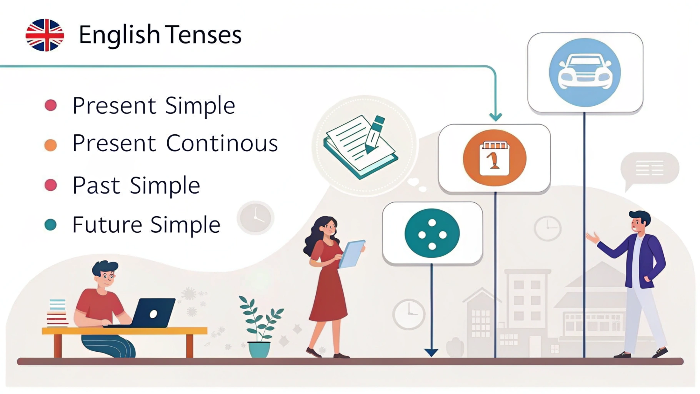
Tenses show when an action happens — in the past, present, or future.
In this simple guide, you’ll learn all 12 English tenses with clear meanings, examples, and easy explanations. Whether you’re a beginner or want to review your grammar, this lesson will help you master English tenses step by step.
English Tenses Explained with Examples (Simple Guide)
📘 1. Present Simple Tense
Structure:
➡️ Subject + Verb (base form) + Object
Use:
To describe habits, facts, or general truths.
Examples:
- I study English every day.
- The sun rises in the east.
🕐 2. Present Continuous Tense
Structure:
➡️ Subject + am/is/are + Verb + ing
Use:
For actions happening now or around the current time.
Examples:
- She is reading a book.
- They are watching TV right now.
📗 3. Present Perfect Tense
Structure:
➡️ Subject + has/have + Past Participle
Use:
To talk about actions that happened at an unspecified time or have results in the present.
Examples:
- I have finished my homework.
- He has already eaten dinner.
🕓 4. Present Perfect Continuous Tense
Structure:
➡️ Subject + has/have been + Verb + ing
Use:
To show an action that started in the past and continues now.
Examples:
- I have been studying English for two years.
- She has been working since morning.
📘 5. Past Simple Tense
Structure:
➡️ Subject + Verb (past form) + Object
Use:
For actions completed in the past.
Examples:
- I watched a movie yesterday.
- They visited London last summer.
🕐 6. Past Continuous Tense
Structure:
➡️ Subject + was/were + Verb + ing
Use:
To describe an action that was happening at a specific time in the past.
Examples:
- I was sleeping when the phone rang.
- They were playing football at 5 p.m.
📗 7. Past Perfect Tense
Structure:
➡️ Subject + had + Past Participle
Use:
For an action completed before another action in the past.
Examples:
- I had finished my work before he arrived.
- She had left when I called her.
🕓 8. Past Perfect Continuous Tense
Structure:
➡️ Subject + had been + Verb + ing
Use:
To show how long an action continued before something else happened.
Examples:
- They had been studying for hours before the exam started.
- I had been waiting for 30 minutes before the bus came.
📘 9. Future Simple Tense
Structure:
➡️ Subject + will + Verb (base form)
Use:
To express future actions or predictions.
Examples:
- I will call you tomorrow.
- It will rain tonight.
🕐 10. Future Continuous Tense
Structure:
➡️ Subject + will be + Verb + ing
Use:
For actions that will be in progress at a specific time in the future.
Examples:
- I will be studying at 8 p.m.
- She will be traveling next week.
📗 11. Future Perfect Tense
Structure:
➡️ Subject + will have + Past Participle
Use:
To show that something will be completed before a certain time in the future.
Examples:
- I will have finished my project by Friday.
- They will have arrived by 9 p.m.
🕓 12. Future Perfect Continuous Tense
Structure:
➡️ Subject + will have been + Verb + ing
Use:
To emphasize the duration of an activity by a future time.
Examples:
- By next month, I will have been learning English for three years.
- She will have been working here for a decade.
📚 Quick Summary Table
| Time | Tense | Example |
|---|---|---|
| Present | Simple | I play football. |
| Continuous | I am playing football. | |
| Perfect | I have played football. | |
| Perfect Continuous | I have been playing football. | |
| Past | Simple | I played football. |
| Continuous | I was playing football. | |
| Perfect | I had played football. | |
| Perfect Continuous | I had been playing football. | |
| Future | Simple | I will play football. |
| Continuous | I will be playing football. | |
| Perfect | I will have played football. | |
| Perfect Continuous | I will have been playing football. |
Tips to Master English Tenses
✅ Practice speaking with real-life examples every day.
✅ Use time expressions like yesterday, now, already, tomorrow to understand the difference.
✅ Don’t memorize — understand the logic behind each tense.
✅ Write one short paragraph for each tense daily to build confidence.
Conclusion
English tenses may seem confusing at first, but once you understand the structure and usage, they become simple.
Learning tenses helps you express time, action, and intention clearly in your speech and writing.
Keep practicing, and soon you’ll speak English fluently and naturally.