
Modal Verbs in English with Examples
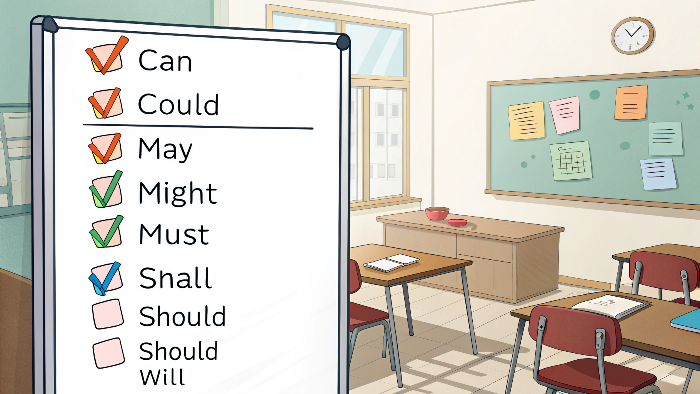
Learning modal verbs is an essential part of mastering English grammar. These small but powerful words help us express possibility, ability, permission, obligation, advice, and certainty.
If you understand how to use modal verbs correctly, your English will sound more natural and fluent. Let’s dive in!
Modal Verbs in English with Examples
🌟 What Are Modal Verbs?
Modal verbs are auxiliary (helping) verbs that show the speaker’s attitude toward an action.
They come before the main verb and never change their form (no -s or -ed).
Common modal verbs:
👉 can, could, may, might, must, shall, should, will, would
Example:
- I can swim.
- She should study more.
- You must wear a seatbelt.
🧩 General Rules of Modal Verbs
- Modal verbs are followed by the base form of the main verb.
- ✅ I can go now.
- ❌ I can to go now.
- They do not take -s, -ed, or -ing.
- ✅ He can drive.
- ❌ He cans drive.
- They don’t need “do/does” in questions or negatives.
- ✅ Can you swim?
- ✅ I can’t dance.
- ❌ Do you can swim?
💪 Common Modal Verbs and Their Uses
| Modal Verb | Meaning / Use | Example Sentences |
|---|---|---|
| Can | Ability / Possibility / Permission | I can play the guitar. / Can I go out? |
| Could | Past ability / polite request / possibility | I could run fast when I was young. / Could you help me? |
| May | Permission / possibility | You may enter the room. / It may rain today. |
| Might | Small possibility | It might snow tomorrow. |
| Must | Obligation / strong belief | You must wear a helmet. / She must be tired. |
| Shall | Formal suggestion or future (mainly UK English) | Shall we dance? / We shall meet again. |
| Should | Advice / expectation | You should eat more vegetables. / He should be here by now. |
| Will | Future / willingness | I will call you tomorrow. |
| Would | Polite request / hypothetical situation / past habit | I would love some coffee. / He would walk every morning. |
🧠 How to Form Negative and Question Sentences
Negative:
Add not after the modal verb.
- I cannot (can’t) drive.
- You should not (shouldn’t) eat too much sugar.
Questions:
Put the modal verb before the subject.
- Can you help me?
- Should we leave now?
- Will they come?
🎯 Modal Verbs for Possibility
| Modal | Meaning | Example |
|---|---|---|
| May / Might | Possible in the future | It may rain later. |
| Could | Possible but uncertain | She could come to the party. |
| Must | Almost certain | He must be the new teacher. |
| Can’t | Impossible | That can’t be true! |
🗣️ Modal Verbs for Advice and Obligation
| Function | Modal Verb | Example |
|---|---|---|
| Obligation | must, have to | You must pay your taxes. / You have to go to school. |
| No Obligation | don’t have to | You don’t have to come if you’re busy. |
| Advice | should, ought to | You should sleep early. / You ought to drink more water. |
💬 Polite Requests and Offers
| Function | Modal Verb | Example |
|---|---|---|
| Request | can, could, would | Could you open the window, please? |
| Offer | shall, will, would | Shall I help you? / Would you like some tea? |
🧩 Modal Verbs in Past Form
Some modals can be used with have + past participle to talk about the past.
| Form | Use | Example |
|---|---|---|
| must have + past participle | something was certain in the past | She must have forgotten her keys. |
| might have / could have + past participle | something was possible but didn’t happen | I could have gone, but I stayed home. |
| should have + past participle | advice about the past | You should have studied harder. |
💰 Improve Your Grammar with Smart Tools (High CPC Section)
If you want to master modal verbs faster, try using AI-powered grammar tools that analyze your sentences in real time.
Top-rated tools include:
- Grammarly – checks your modal verbs and corrects mistakes.
- QuillBot – helps rewrite sentences using correct modals.
- Ginger Software – offers free grammar lessons and exercises.
💡 SEO Keywords: best English grammar app, learn English online, grammar checker for students, practice modal verbs.
These resources are great for learners — and for AdSense, they attract high-value ads!
🧾 Quick Practice Exercise
Complete these sentences with the correct modal verb:
- You ___ finish your homework before playing.
- ___ I use your phone, please?
- He ___ be the new manager.
- We ___ go to the party, but we’re not sure yet.
- She ___ swim when she was five.
(Answers: must, may, must, might, could)
🎓 Final Tips
- Learn the meaning and feeling of each modal verb.
- Don’t memorize — practice in context.
- Watch English movies or shows and listen to how native speakers use can, could, should, and others naturally.
- Make your own sentences every day!
💡 Conclusion
Modal verbs make your English more expressive, polite, and powerful. They allow you to talk about possibilities, obligations, and abilities with confidence.
Keep practicing daily — soon you’ll sound fluent and natural when using can, could, may, might, must, should, will, and would.

Interesting I’m enjoying and learning at the same time